In the first half of this year, HGC Haisen Overseas Warehouses took the lead in completing the construction of 10 major warehouse clusters in the United States, and continued to expand its warehouse network across 15 European countries. Today we highlight our new partners launched in H1: the Seattle and Norfolk warehouses in the U.S., and the Poland warehouse in Europe.
In times of uncertainty, reliable overseas warehouses are essential to hedge risks. With peak stocking season approaching, we welcome inquiries and cooperation.
15+13: Further Densifying the Europe-U.S. Warehouse Network
As of the first half of the year, HGC Haisen Overseas Warehouses has accelerated its global warehousing area to 2.6 million square meters (≈28 million square feet), with over 100 order processing centers, a daily order volume of 1.2 million, and more than 10,000 employees worldwide. The U.S. and Europe remain our key focus markets, with new warehouses launched and existing ones expanded and upgraded.
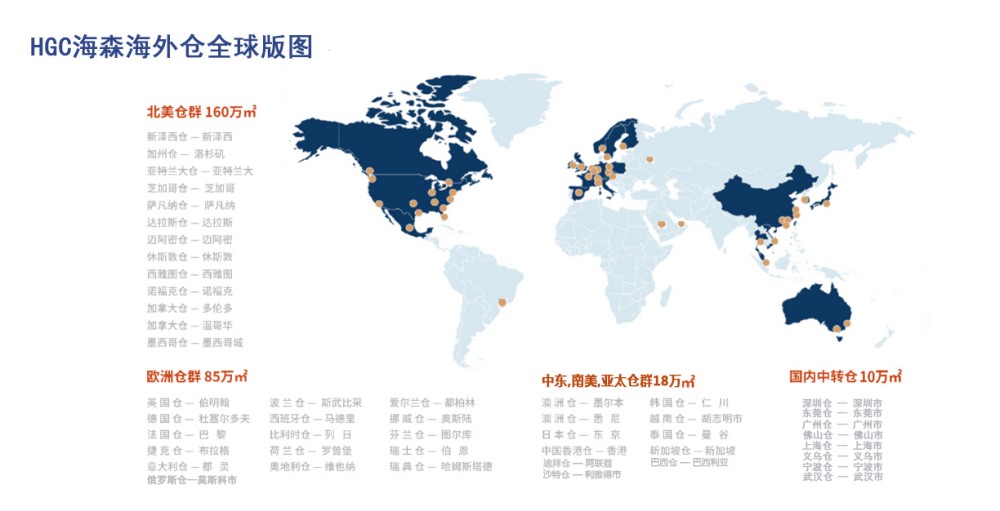
The newly launched Seattle warehouse in the U.S. covers 20,000 square meters, and the Norfolk warehouse 15,000 square meters. Both sites were selected based on logistics location, order density, and delivery efficiency. With these additions, the total warehousing area across three North American countries has exceeded 1.6 million square meters, forming an integrated North American fulfillment network: 10 major warehouse clusters in the U.S., 2 in Canada, and 1 in Mexico.
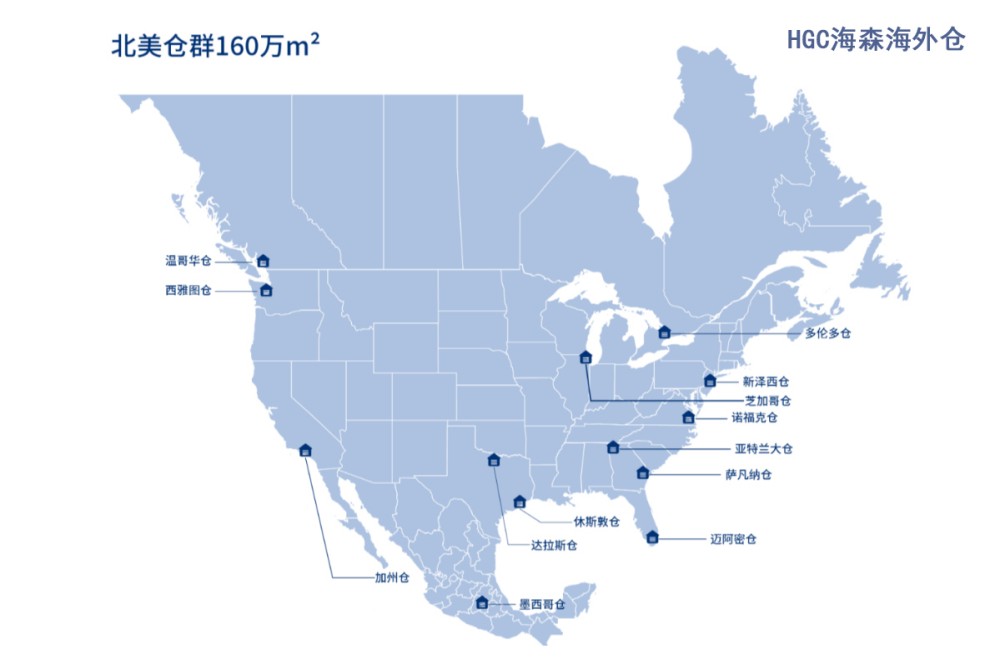
Strategic nodes have been further deployed along the East and West Coasts. The launch of the Seattle and Norfolk warehouses reflects both logistics planning and commercial demand.
First, last-mile cost reduction: the two new warehouses significantly shorten delivery radii in the U.S. Northwest and East Coast. Combined with HGC Haisen’s flagship GC Parcel service, the integrated warehouse-and-delivery model helps sellers cut last-mile costs.
Second, faster delivery: more warehouse clusters support zoned fulfillment, covering more cities locally and enabling more same-day, next-day, and second-day deliveries.
Third, transit support: the Seattle warehouse not only serves the U.S. Northwest but also eases pressure on surrounding warehouses. Located in the mid-section of the East Coast, the Norfolk warehouse connects four major regions: the South, Southeast, Mid-Atlantic, and Upper Mississippi Valley.
In Europe, HGC Haisen has expanded its warehouse footprint to 15 countries, with a total area of 850,000 square meters, making it a key region for both quantity and quality growth in storage capacity and new zones over the past two years.
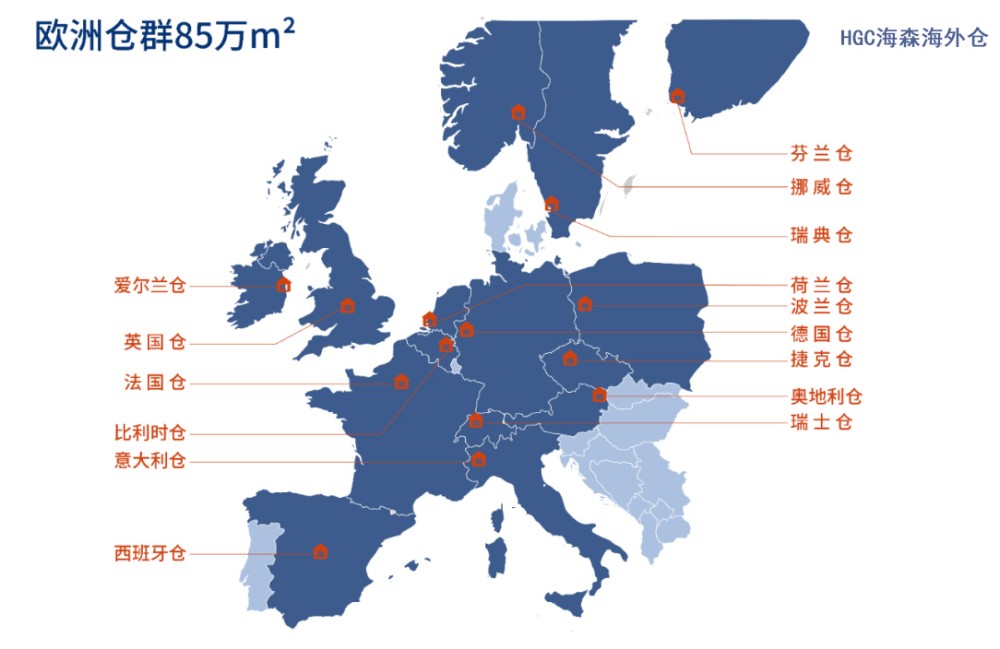
In Western Europe, investment continued in warehouses in Italy and Spain. The launch of a 24,000-square-meter dual warehouse in Poland extends the network eastward from Western Europe and Central Europe (Czech Republic) across the European continent, laying a foundation for sustainable growth in cross-border e-commerce operations in Europe. Meanwhile, warehouse expansions across European countries have densified the regional network, integrating 15 national networks into a unified European system. Growing storage capacity and economies of scale have accelerated cost reduction and efficiency gains.
As HGC Haisen Overseas Warehouses continues to scale up, it also focuses on breakthroughs and upgrades to its operating system. Adhering to a philosophy of “proactive but not radical, steady but not conservative”, the company strengthens its competitive advantages through storage capacity and geographic coverage, laying a solid foundation for a graded warehouse network and business expansion. It provides integrated 3PL warehousing and fulfillment services to e-commerce merchants, managed sellers, brands, and other clients.
Advantages of New Warehouses: Seattle, Norfolk & Poland
1. Seattle: Home to Amazon, economic hub and logistics gateway of the U.S. Pacific Northwest

· Concentration of high-income buyers
Seattle hosts Fortune 500 headquarters including Amazon, Microsoft, Costco, Starbucks, Boeing, and Alaska Airlines, plus R&D centers for Google, Meta, and Apple. Over 100 high-tech enterprises relocated or expanded here in 2025. Tech workers earn 13% above the national average (e.g., software engineers at ~$120,000 annually), supporting strong e-commerce purchasing power.
· Demographic dividend
Seattle ranks among the top 50 fastest-growing and most populous U.S. cities (18th overall) and is projected to surpass San Francisco within two years, offering strong incremental buyer potential. The population is 71.9% White, 9% Hispanic, 8.7% Asian, and 5.6% African American, with a per capita GDP of $125,000 (third highest in the U.S.), matching core e-commerce consumer profiles. A growing young and millennial population benefits fashion, 3C, home, garden, and beauty categories.
· Logistics and distribution hub
The Port of Seattle is the second-largest container port in the U.S. and the closest major port to the Far East. Seattle-Tacoma International Airport (SEA) is a regional air hub, linked by Interstate 5 (north-south) and Interstate 90 (east-west), forming a multimodal sea-air-rail-road network.
HGC Haisen’s Seattle warehouse is located near ports, airports, and multiple FBA facilities. This “Northwest development” diverts fulfillment pressure from California warehouses, sharply cuts delivery times for the U.S. Northwest, and helps clients capture high-value regional buyers.
2. Norfolk: East Coast logistics gateway and world-class deep-water port
· Core of the East Coast economic circle
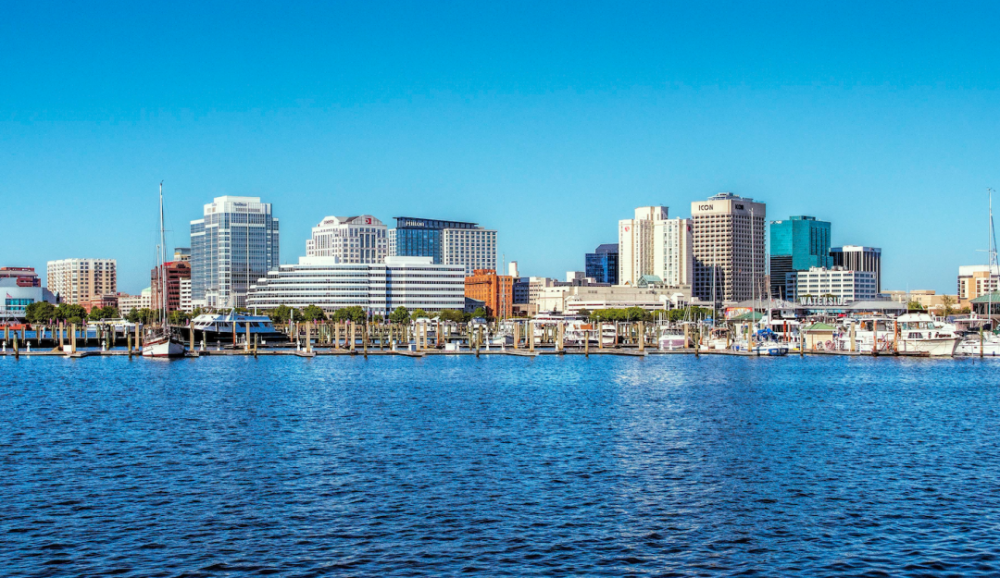
Norfolk is Virginia’s second-largest city and port, known for port economy, military bases, and shipbuilding. As the heart of the Hampton Roads metro area (population >1.8 million, 50% aged 18–55), it is a major population center on the U.S. East Coast. The metro area generated ~$127.4 billion in GDP in 2023 (17% of Virginia’s total), with robust consumer vitality critical to East Coast and U.S. foreign trade.
· Connection to the Washington consumption circle
Leveraging its deep-water port, rail links, and interstates I-64/I-95, Norfolk forms the southern wing of the mid-Atlantic corridor linked to the Washington-Baltimore metro area — the fourth-largest retail market in the U.S., with a median household income of $93,000, high population density, and strong e-commerce demand. The Norfolk warehouse serves as a forward stocking location for the entire East Coast urban belt.
· Deep-water logistics hub
Norfolk is home to the world’s largest naval base and boasts exceptional natural port advantages. With a 55-foot channel depth — the deepest on the East Coast — it can accommodate the world’s largest container vessels. Over 6,500 feet of berthing space allows simultaneous large-vessel operations, ensuring high efficiency and leading throughput among U.S. ports. As container ships grow larger, Norfolk’s deep-water value becomes increasingly strategic for cross-border e-commerce entering the U.S. East.
· Inland logistics gateway
Norfolk’s strategic location and multimodal links make it a gateway to the inland supply chain. The port handles cargo from Europe, Africa, and Asia via the Suez Canal, with rail connections to Chicago, Memphis, and other Midwestern hubs, and road links to inland destinations, cutting overland transit times. Norfolk International Airport also serves as a major air cargo hub with global connections.
In late July 2025, Union Pacific (UNP), North America’s largest railroad, announced the acquisition of Norfolk Southern (NS), planning the first transcontinental east-west freight rail line. Their combined 83,000-kilometer network covers 45 U.S. states, greatly reducing risks of congestion, labor strikes, and weather disruptions that trouble sellers.
3. Poland Warehouse: Crossroads of Eurasia, one of Central and Eastern Europe’s largest economies

· Strong economic growth drives consumption
Poland’s GDP grew by over 3% for four consecutive quarters through 2025, maintaining long-term momentum. Per capita GDP reached $18,000 in 2023, supporting solid consumer purchasing power. The National Bank of Poland projected 2.9%–4.6% GDP growth in 2025, creating a strong economic foundation for cross-border e-commerce.
· Top-tier e-commerce growth market
Driven by steady growth, a large consumer base, mature e-commerce infrastructure, and supportive policies, Poland’s e-commerce sector has boomed. Sales reached $43.3 billion in 2024 (25% of Central and Eastern Europe’s market), with a projected 7.4% increase to $46.5 billion this year and 8% annual growth over the next four years — ranking third only behind Germany and Hungary, making it a high-potential European market. Along with local platform Allegro, Amazon, Temu, and others have entered, further lifting Poland’s e-commerce and logistics sectors.
· Young, high-quality buyer base
Poland had a population of ~36.6 million in 2024 with a median age of 40.6, making it the second-youngest country in Central and Eastern Europe. 64% of the population shops online across all age groups. Younger shoppers show growing enthusiasm, middle-aged groups form the core, and the senior online shopper share surged from 12% to 35% over a decade, creating opportunities for related categories.
· Logistics hub linking Western, Central, and Eastern Europe
Located at the heart of Europe and along the Belt and Road Initiative, Poland has extensive road and rail networks with direct border crossings to neighboring countries, reaching Western and Central/Eastern Europe. It hosts the second-largest container port on the Baltic Sea, connecting to Northern Europe and the UK. It is also the first EU stop on the China-Europe Railway Express and a key transit hub for Chinese cross-border cargo, allowing sellers to cut logistics transfer costs significantly.
HGC Haisen’s Poland warehouse is located in Słubice, a western Polish city near the German border, featuring a 25,000-square-meter dual-warehouse layout for mutual support and risk diversification. Słubice is a major European land transport hub, close to HGC Haisen’s mature European clusters: a 310,000-square-meter Germany warehouse and 110,000-square-meter Czech warehouse. Together with the 850,000-square-meter regional network, they provide comprehensive support to sellers.
Tariff wars reflect profound shifts in the global division of labor — a reality that will persist regardless of political changes. Tariffs have become a long-term background for Chinese sellers going global. Overseas warehouses are essential infrastructure for adapting to the shift from globalization to regionalization.
In the first half of the year, HGC Haisen Overseas Warehouses continued heavy asset investment globally, launching new facilities and expanding existing ones. This forward-looking layout responds to the new competitive landscape, aligns with its parent company’s long-term vision as a “global cross-border e-commerce infrastructure provider”, and reflects confidence in China’s global expansion despite tariff headwinds.
Going forward, HGC Haisen Overseas Warehouses will continue building a competitive fulfillment network through supply chain thinking and heavy-asset investment, staying ahead in infrastructure development to deliver new pathways for logistics cost reduction, efficiency, and speed, and providing high-quality support for clients’ supply chain restructuring.